Shop
Product design for Shopify's e-commerce destination app.
- Role
- Product Design Contractor
- Timeline
- Sep. 2022 - Jan. 2023
- Team
- mentored by Jess Erickson and Josh Sucher
Overview
Product design for Shopify's e-commerce destination app
In the Fall of 2022, I had the opportunity of contracting with Shop to research the e-commerce space the app occupies and how it can better cater to internet-savvy consumers, specifically that of Gen-Z.
The Shop UX team was specifically interested in what mobile features could manifest from Gen-Z's unique shopping habits, in addition to how habits like social shopping could incentivize more purchases.
What's Shop?
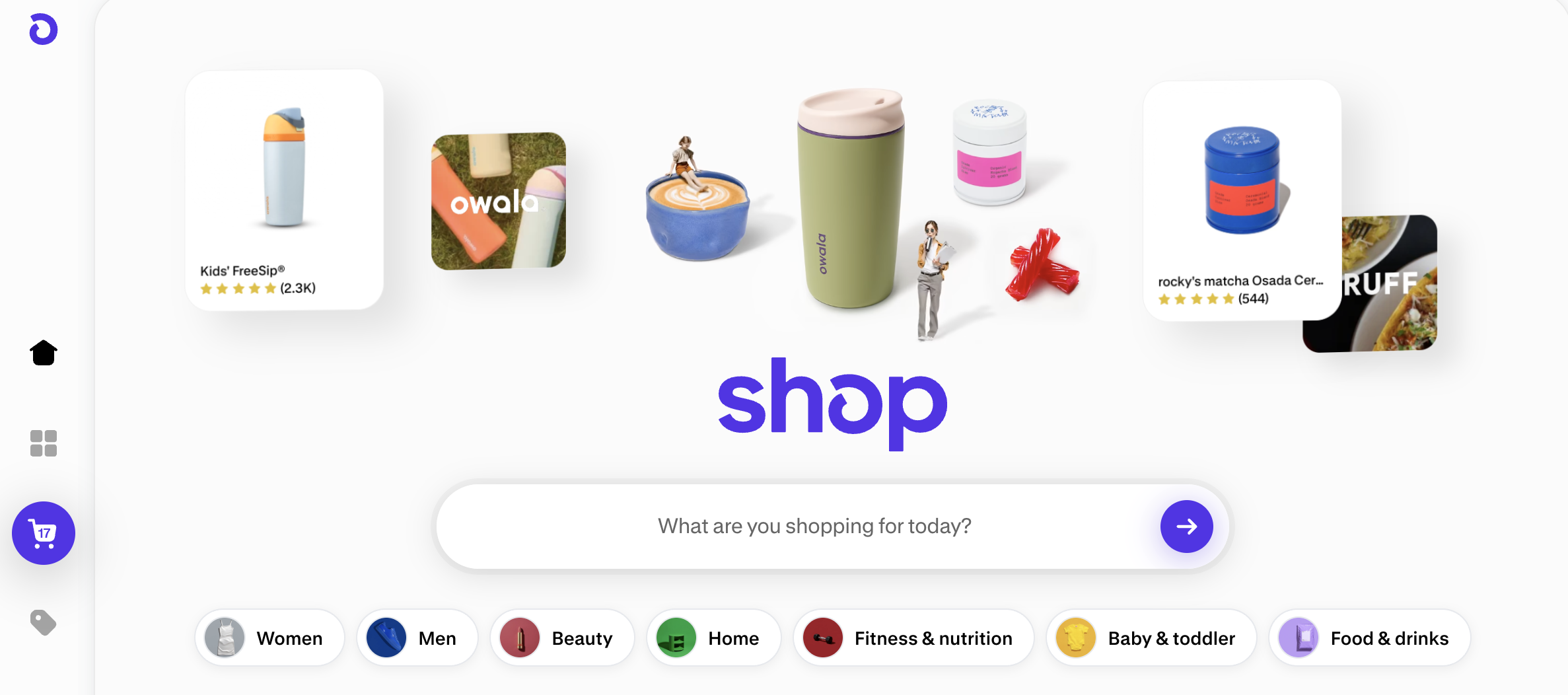
The Shop app is Shopify's consumer app. It's a shopping destination and delivery tracking app with the goal of "consolidating stores into a cohesive shopping experience." The app is also powered by a payment method called Shop Pay. The Shop app launched in 2020 & was originally a tracking-focused app called Arrive. It is currently third in the App Store on the "Shopping" app rankings.
The problem
Shop aims to become a consumer app that gives users the ability to explore vendors and consolidate their online purchases.
Shopify was looking to create a destination they can own to capitalize on native capabilities, and to better leverage customers by offering a marketplace of diverse vendors. However, they faced difficulties in converting users into marketplace buyers.
The purpose of Shop
The Shop app is meant to accompany Shopify's e-commerce ecosystem, which boasts a variety of brands that are well known to smaller, mom-and-pop shops. Shopify is meant to empower a breadth of businesses, and Shop is its streamlining companion. As an app, Shop boasts seamless package tracking and accessible order histories from Shopify/Shop brands, brand discovery, exploration, and more.
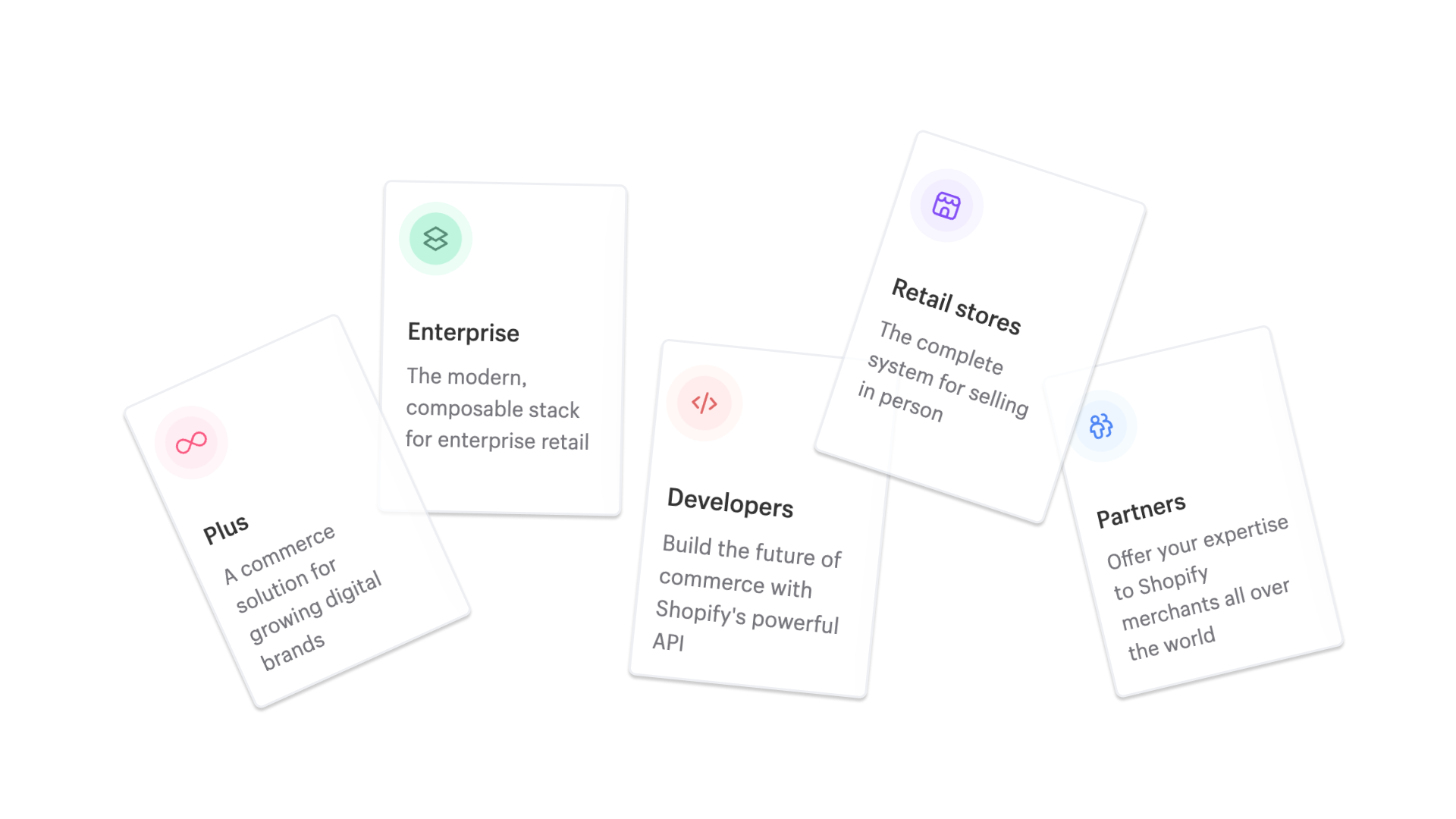 Shopify's e-commerce ecosystem strategy aims to connect e-commerce stores to the hands of online customers, physical brick and mortar stores, and beyond.
However, many people were confused by Shop's function, and most associated it with tracking.
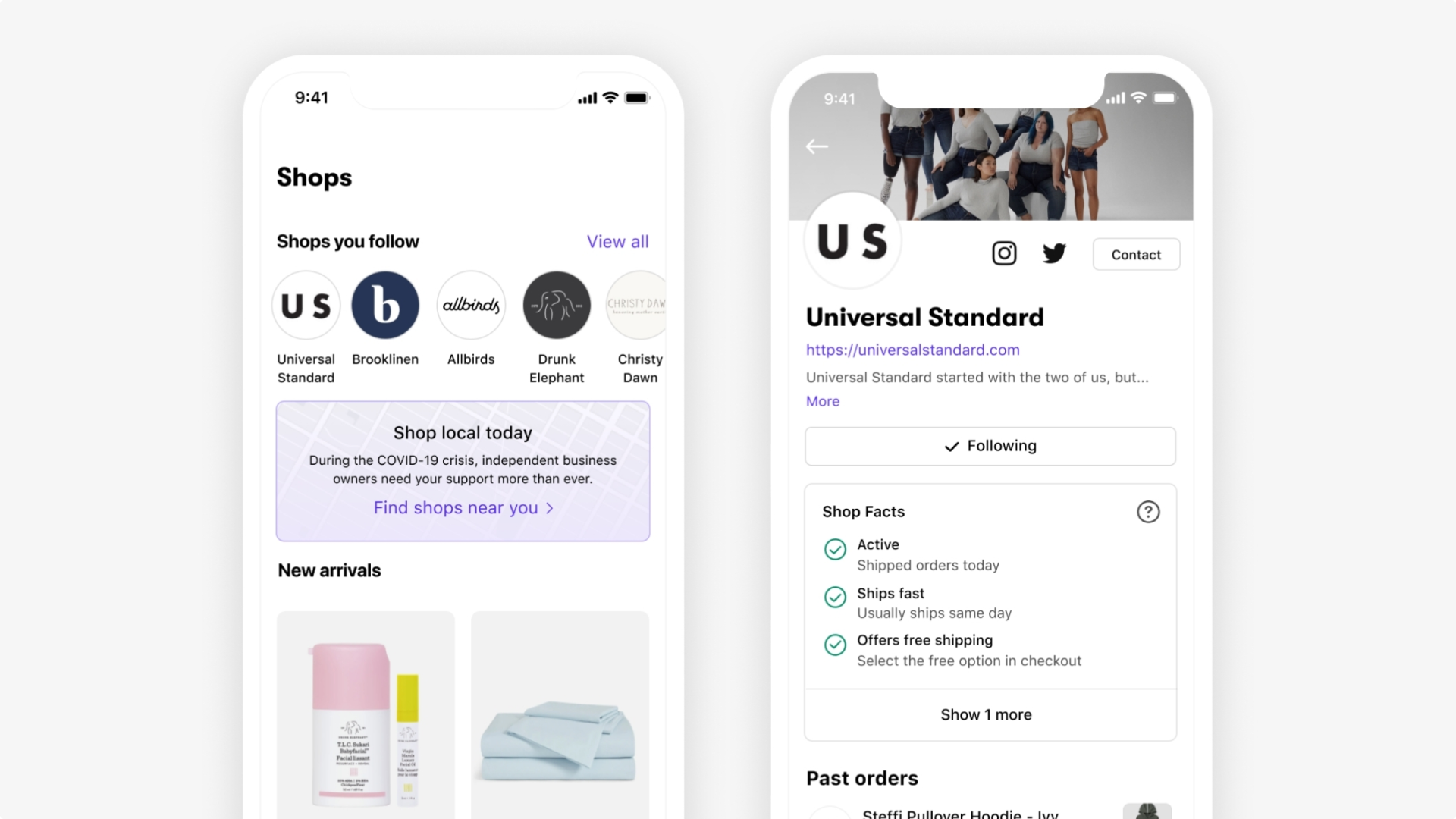 Shop's tracking feature
When initially asking friends and family about Shop before releasing our screener survey, we received many comments saying people used it casually to track packages — these sentiments helped us develop insights on the research to come.
Ultimately, Shop wants to be seen as a product discovery tool for e-commerce shoppers and younger people.
Shop was looking to harness the power of its user base to transform its platform into an avenue for product discovery, product collection, and purchasing. Shop was also specifically interested in targeting Gen-Z folk because of their collective buying power — at over 360 billion dollars in disposable income per year, Gen-Z is a force to be reckoned with in the e-commerce space.
Impact
A peek at the work I helped shape and influence
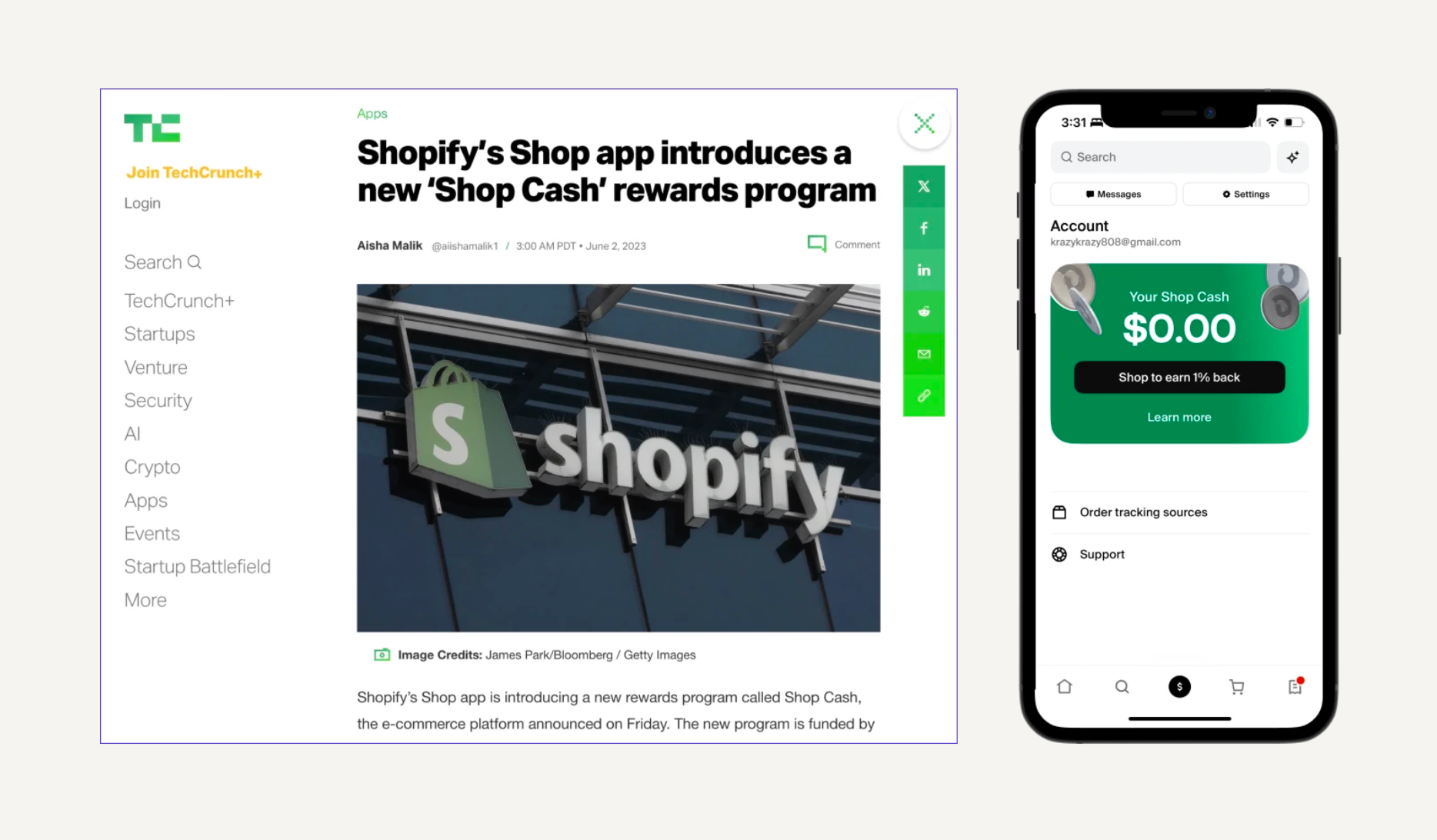 Here's a sneak peek of some of the work I helped shape and influence, including a rewards system called Shop Cash and a shopping catalog system called Collections.
Solution
This section of my case study is ~ under construction ~
Thank you for your patience as I retrieve the most updated visuals needed!
Shop Cash
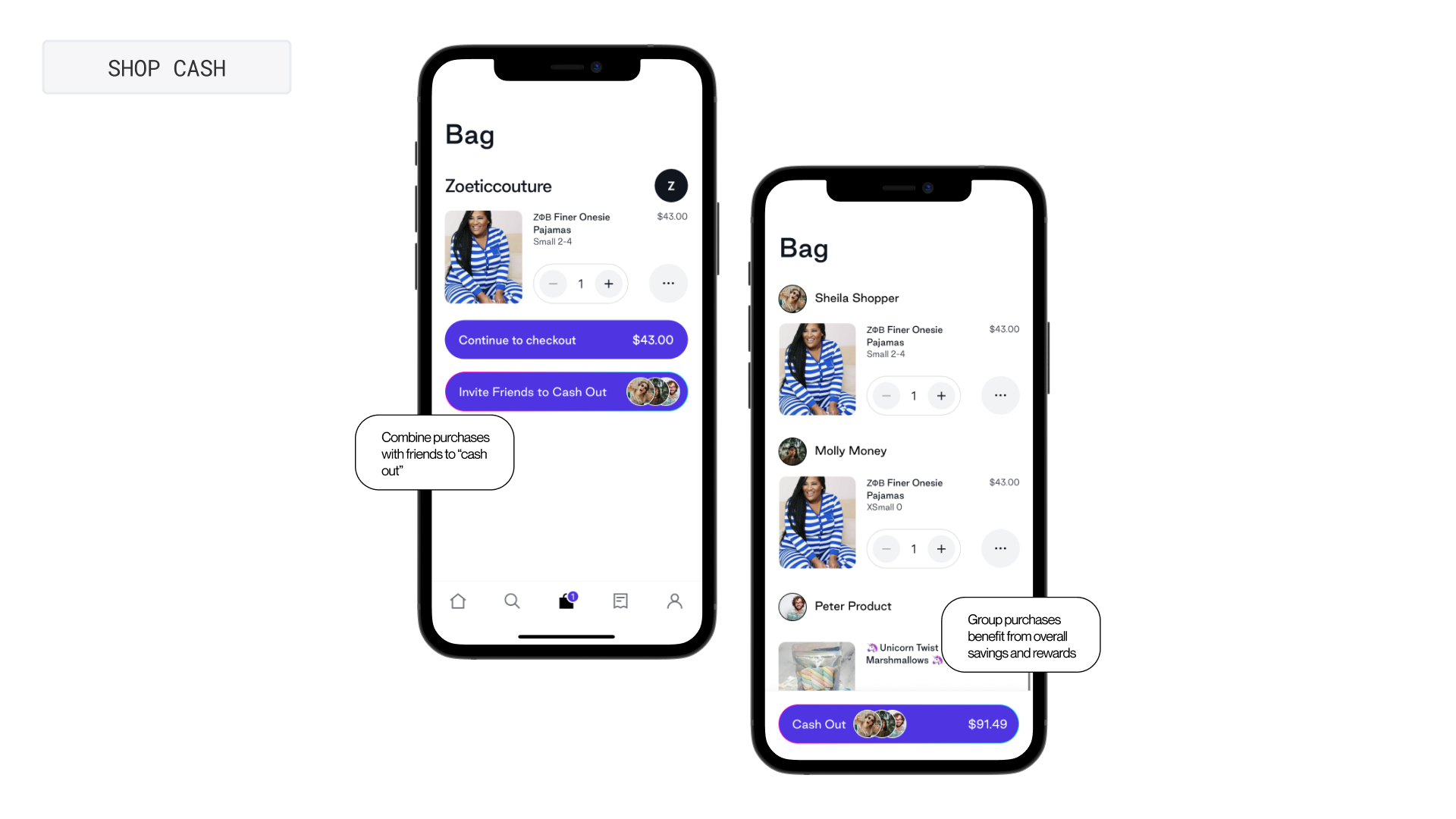
In June of 2023, Shopify launched one of my project concepts, Shop Cash, as a loyalty rewards program for its users. Shop Cash has no monetary value outside of the Shop app but is mainly a cash-back/rewards system that encourages user growth and loyalty.
Shop Collections
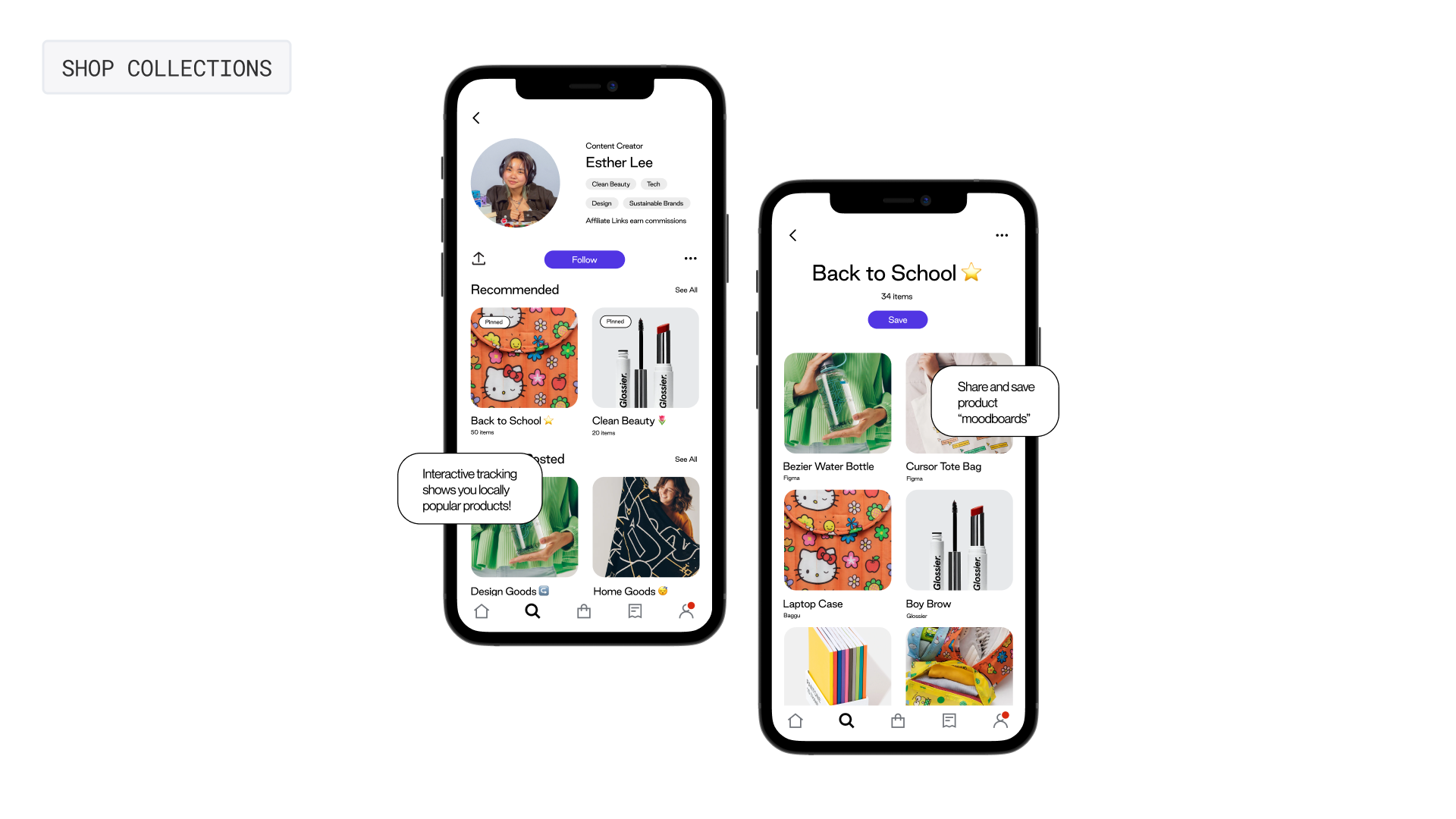
Shopify also launched another feature concept this past year called Shop Collections -- Shop Collections is essentially a way to organize your "saved" items on Shop. It allows you to share, catalog, archive, and file potential purchases.
Research
I conducted surveys, interviews, and more in order to understand the current landscape.
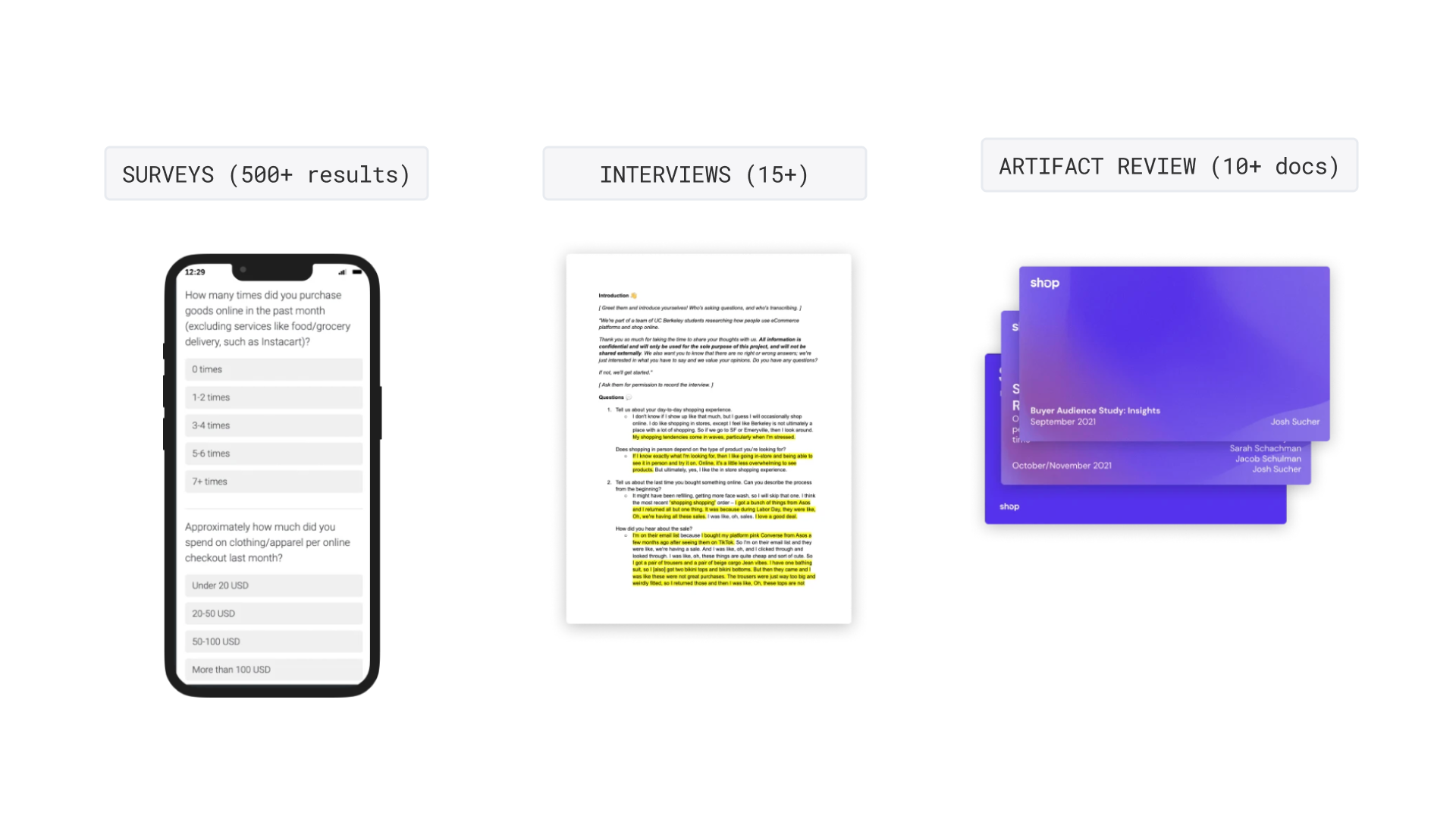 Here are some of the methods I used during my research process.
With the help of the other contractors on my team, I conducted a screener survey, ethnographic interviews, and concept validation exercises that targeted high school and college aged students in order to answer a number of questions we had about the current e-commerce eco-system as seen through Gen-Z.
I found that Gen-Z-ers face many influences during their shopping journeys.
- Peer pressureValidation from social networks can hold weight in the decision to buy.
- Getting thriftySecond-hand shopping is a major player within Gen-Z culture and fashion.
- Information fatigueGen-Z-ers utilize multiple platforms, loopholes, and decision-making factors during purchase-making.
And that the social media discovery-to-purchase pipeline involves many steps…
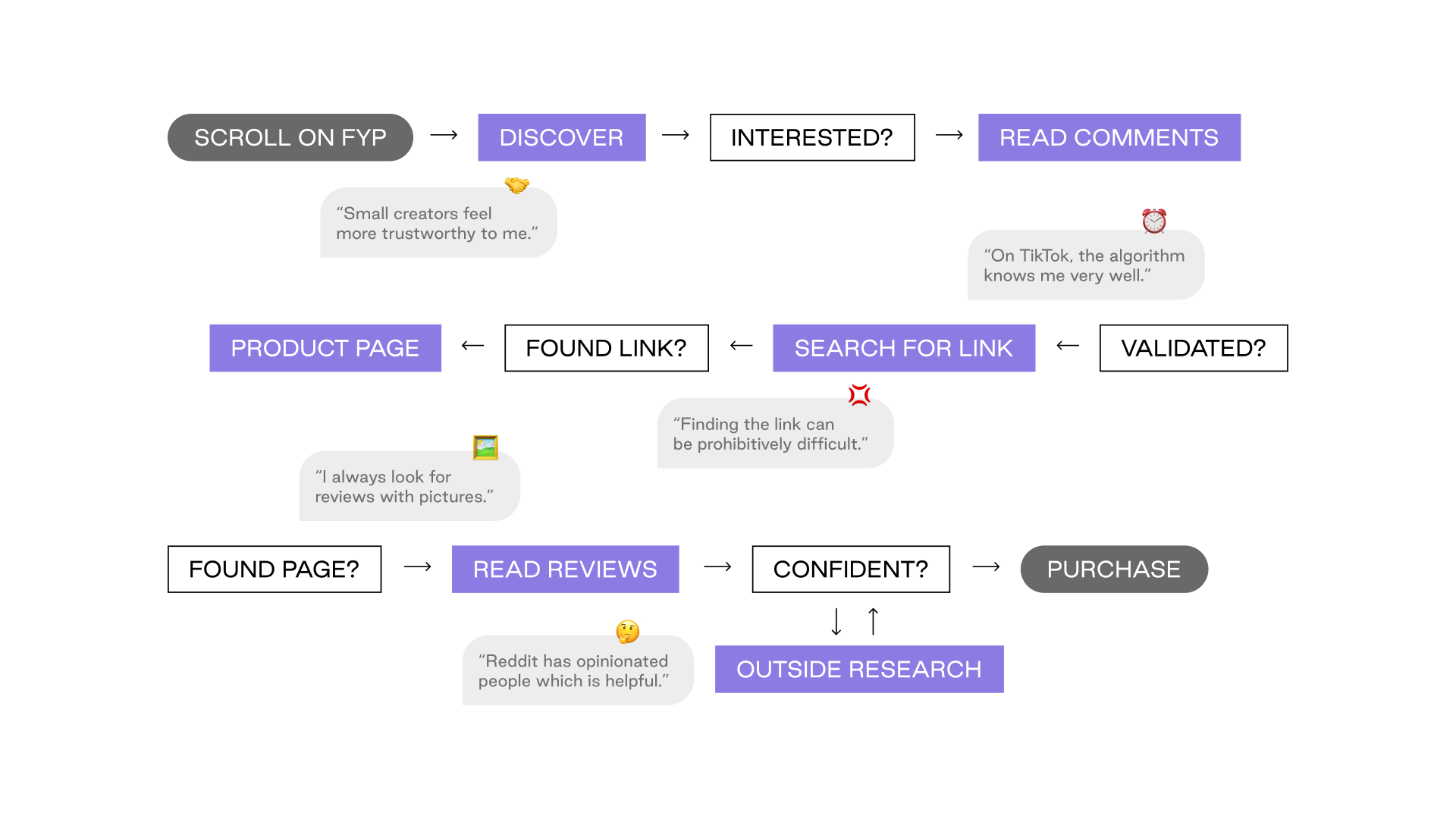 We made this "journey map" of an average shopping journey from discovery to purchase.
Gen-Z-ers utilize multiple platforms, loopholes, and decision-making factors during purchase-making. Nowadays, creators leverage their organic insights and experience in exchange for brand publicity and trust. This gives Gen-Z'ers a myriad of resources to engage with and research through when they purchase products.
I found that the journey from discovery to purchase is often over-saturated and complicated.
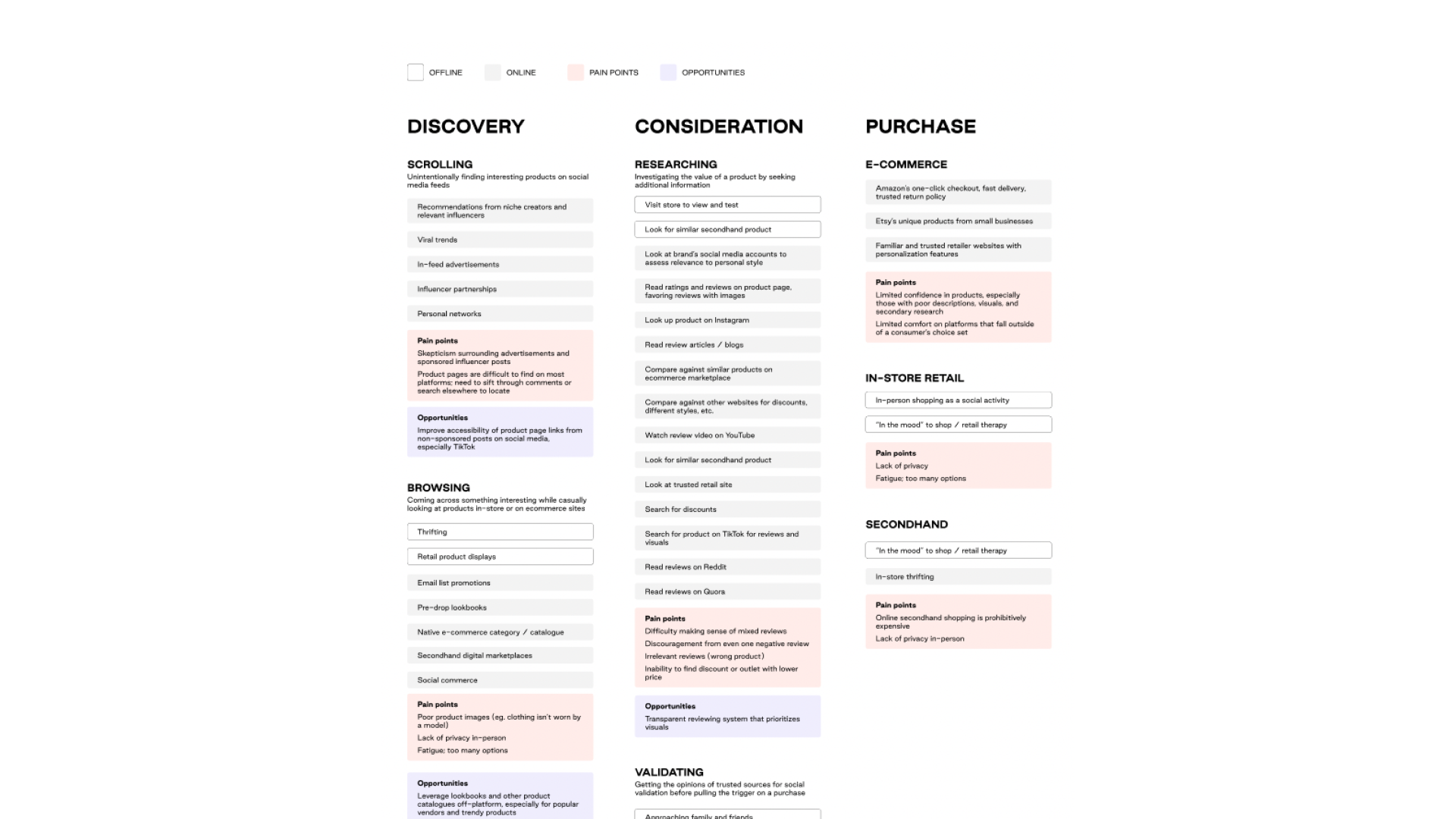 We compiled hundreds of insights to create a not-so-typical "journey map" in order to organize all our thoughts.
There's so much information Gen-Z consumes in the modern e-commerce space in addition to their actual consumption of products. Factors such as in-person versus online experiences were considered, with a heavy emphasis on the several online routes that allow for product research.
Ideation
Making shopping playful.
My team and I were interested in implementing our research by creating design solutions that would drive interest and motivate young shoppers to explore Shop's diverse e-commerce space. We used the crazy-8's method to ideate 15+ ideas, then focused on 3.
Solutions
Shop Cash: the more you invite, the more you save.
Key observations
Gen-Z users love social shopping, and they also love a good deal. I drew inspiration from apps such as Snackpass that utilized group features to encourage bundled check-outs. Shop Cash was also meant to double as a loyalty for users to choose Shop as their main platform in order to reap rewards.
How it works
Utilize "Shop Cash" as a social feature that multiplies your rewards based on the number of people that partake in the purchase. Receive discounts as a group and inspire in-app loyalty!
Shop Cash was implemented in the Shop app this past June 2023 as a rewards program to incentivize shoppers to make repeat-purchases. Their goal with Shop Cash was to create user loyalty, contribute to the larger Shop ecosystem, and create rewards for consumers.
Personal Collections: create wishlists of all your favorite products.
Key observations
While many websites and retail brands allow users to make accounts and "save" items, a more comprehensive solution that allows users to save items across multiple brands and storefronts doesn't exist outside of platforms like Amazon.
How it works
Drawing from Shop's selected brands, users can "save" items to their collections (think of a playlist, but for items!) and title collections with different themes/priorities.
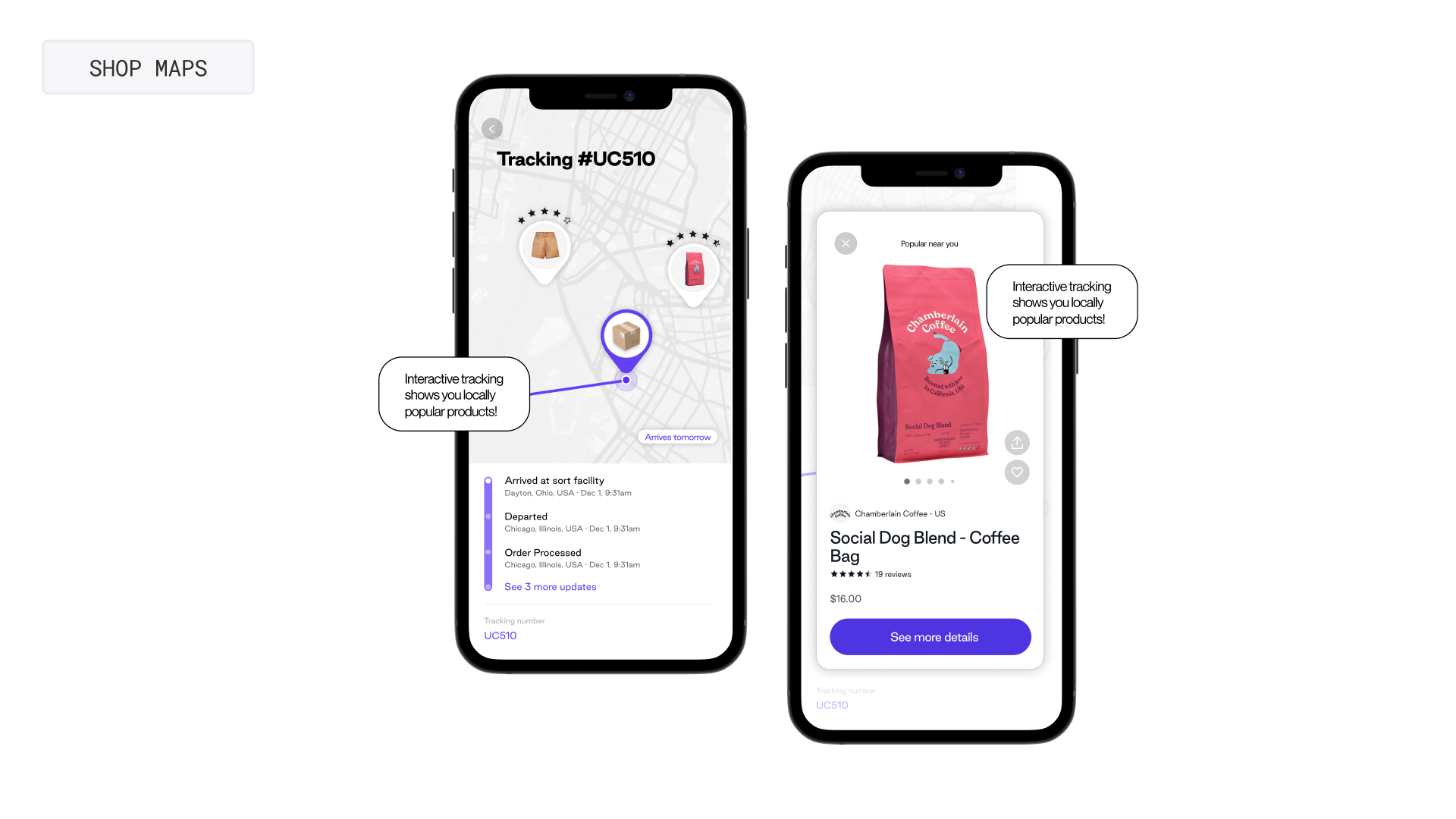
Shop Maps: take shopping locally to a new level.
Key observations
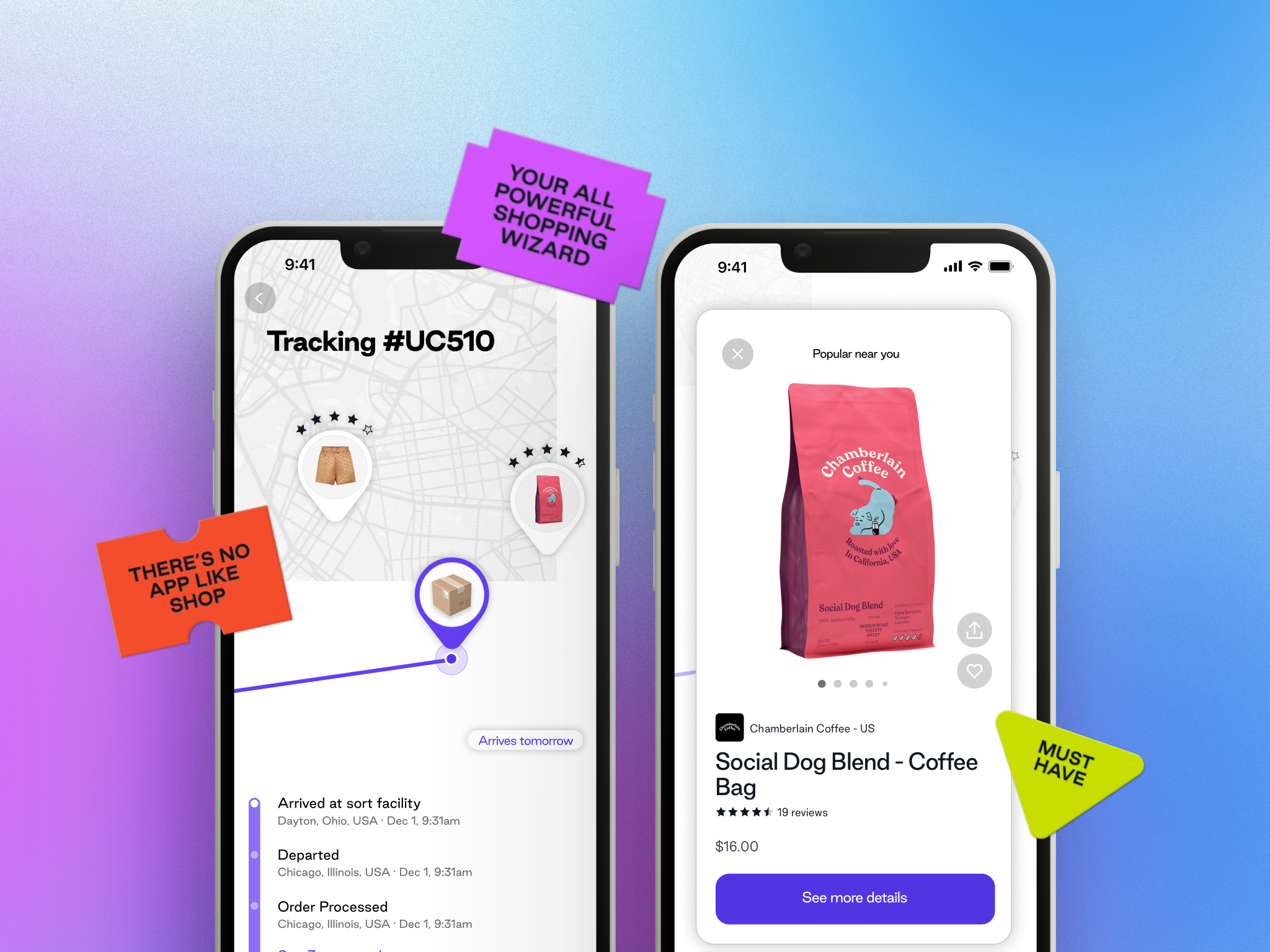
Many Gen-Z shoppers unknowingly use the Shop app to track packages, but the connection between its tracking function and shopping function is not clear to users.
How it works
Every time a user tracks a package, photos of popular products recommended to them in their area pop up too. Clicking into a product reveals its details and the value of the app's native shopping features.
Reflections
Special thanks to the Shop UX team
If you made it this far — thanks for reading! Thank you to my project clients Josh Sucher and Jess Erickson for your thoughtful guidance.
A well-researched product is more important than a flashy one
Although visual delight is key in inspiring and motivating consumers to use a product regularly, a well-researched product is more important than a flashy one. Although this project's final deliverable was research-heavy, we were able to create visual deliverables on a short timeline because we knew exactly what we wanted and we had comprehensive UX research to back it.
The social consumer space is expanding
It was interesting to see how the social consumer space was affecting e-commerce, and how apps that are seemingly focused on markets outside of social media (ie, Duolingo or Doordash) are expanding with social features (ie, Friend streaks and Doordash gifting). People want social connections within technology, and apps that employ social features often win because of it.